

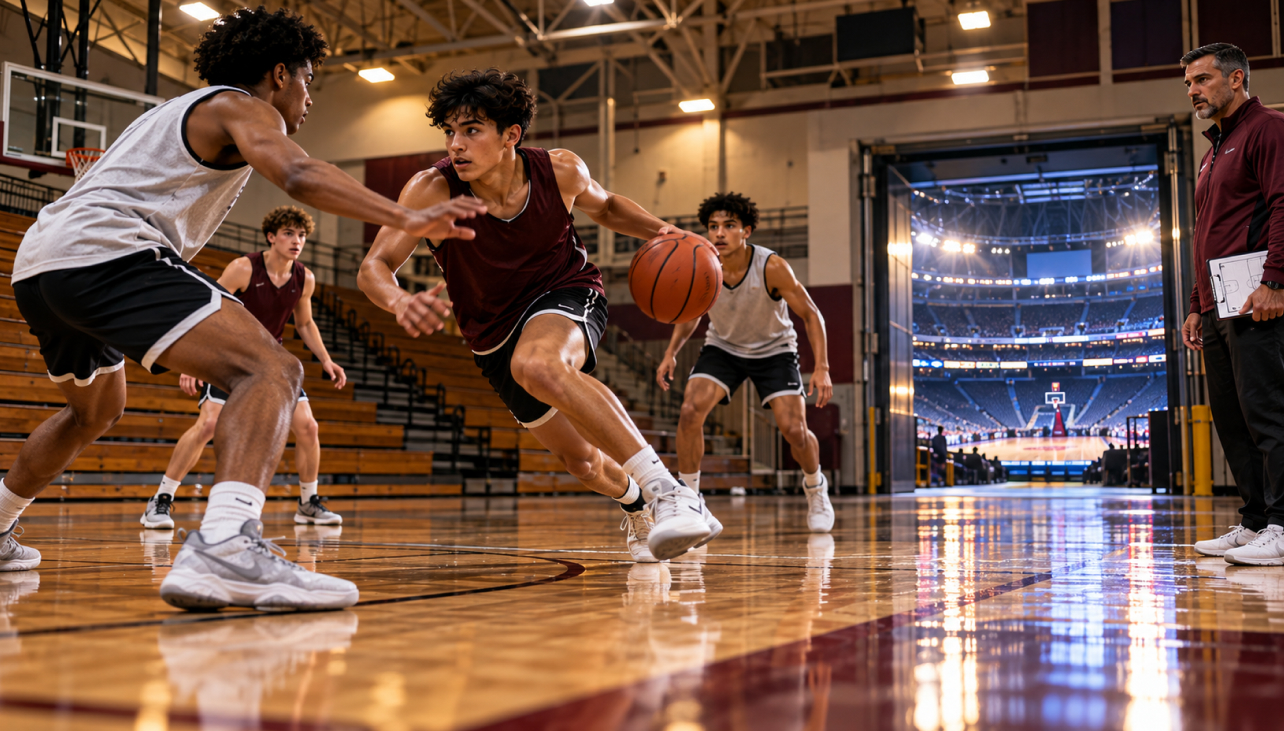
The road to the 2027 Texas high school basketball state championships begins long before the first official game. Across Texas, coaches and student-athletes are preparing for a season in which early practice organization, roster development and district competition will determine who survives the postseason.
According to the University Interscholastic League (UIL), girls’ basketball teams can begin official practice on October 21, 2026, while boys’ teams begin October 28. The one-week difference carries through the opening scrimmage and regular-season dates, creating separate preparation schedules for the two competitions.
The official UIL basketball calendar establishes November 6 as the first date for girls’ interschool games and November 13 for boys. Both seasons will eventually lead to the Alamodome in San Antonio, where the girls’ state finals are scheduled for March 4–6, 2027, followed by the boys’ finals on March 11–13.
For programs in Houston, Dallas–Fort Worth, Austin, San Antonio and smaller communities across Texas, October represents more than the return of organized practice. It is the beginning of a competitive process that rewards preparation, consistency and the ability to develop a team over several months.
As the 2026–27 Texas UIL basketball season approaches, excitement extends beyond high school gyms to the broader basketball community, where fans follow emerging talent, district rivalries, and championship contenders. Adult sports enthusiasts interested in the wider Texas sports landscape may also encounter resources discussing safe offshore sportsbooks for Texans, although these platforms operate outside Texas’s regulated sports betting framework. For players, parents, and coaches, the primary focus remains on athlete development, competitive preparation, and the journey toward the UIL state championships in San Antonio.
Texas UIL Basketball 2026–27: Important Dates For Girls And Boys
The UIL’s 2026–27 calendar establishes the major milestones from the opening practice period through the state championships.
| Season Milestone | Girls’ Basketball | Boys’ Basketball |
|---|---|---|
| First official practice | October 21, 2026 | October 28, 2026 |
| First scrimmages | October 31, 2026 | November 7, 2026 |
| First interschool games | November 6, 2026 | November 13, 2026 |
| District certification deadline | February 9, 2027 | February 16, 2027 |
| Bi-district playoffs | February 11–13, 2027 | February 18–20, 2027 |
| Area playoffs | February 15–16, 2027 | February 22–23, 2027 |
| Regional semifinals | February 18–20, 2027 | February 25–27, 2027 |
| Regional finals | February 22–23, 2027 | March 1–2, 2027 |
| State semifinals | February 27, 2027 | March 6, 2027 |
| State finals | March 4–6, 2027 | March 11–13, 2027 |
Source: University Interscholastic League, 2026–27 basketball calendar. Dates are subject to change.
The schedule creates a compressed opening period. Girls’ programs have 16 days between the first official practice and the opening game date, while boys’ programs have the same interval.
Those 16 days include the first opportunity for scrimmages, meaning coaches must quickly establish team structure, evaluate player combinations and prepare athletes for competitive situations.
The challenge is particularly significant for teams incorporating younger players or adjusting to substantial roster turnover. A talented group of individuals does not automatically become an effective high school basketball team. Players need to understand offensive spacing, defensive responsibilities, transition assignments and how their roles fit together.
Why The October Practice Window Matters More Than It Appears
The opening practice period is one of the most consequential stretches of the high school basketball season because it establishes habits that can remain visible through February and March.
For girls’ programs beginning October 21, the first ten days lead into the October 31 scrimmage opening. Boys’ teams follow the same pattern, practicing from October 28 before their first permitted scrimmages on November 7.
Coaches therefore have limited time to introduce their preferred playing style before opponents begin exposing weaknesses.
A team planning to use aggressive full-court pressure needs coordinated rotations, communication and recovery principles. A program emphasizing half-court execution must establish screening angles, ball movement and spacing before competitive possessions become unpredictable.
The first practices also provide opportunities to identify which players can handle responsibility under pressure. Returning starters may understand the program’s terminology, while younger athletes need time to adapt to varsity-level decision-making.
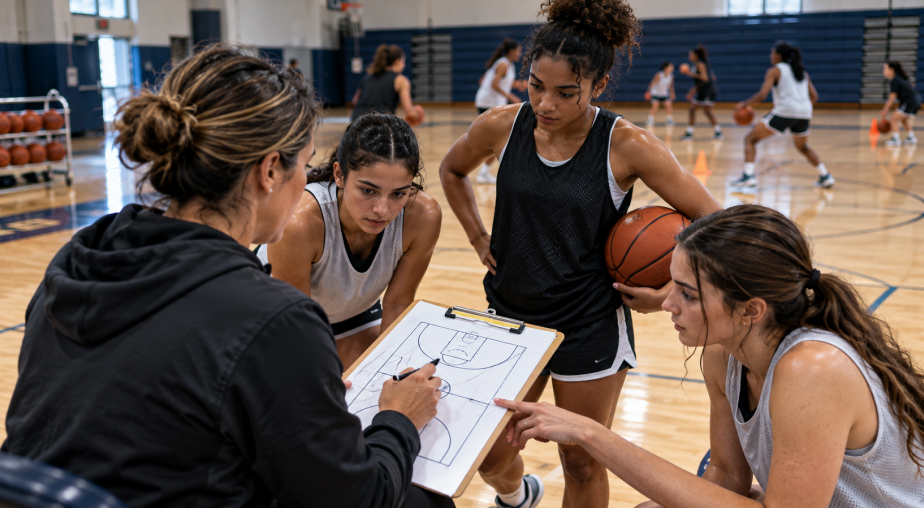
The most effective preparation is not necessarily the most physically demanding. Coaches must balance conditioning, technical instruction and competitive repetition while protecting players from unnecessary fatigue before the season begins.
For Texas basketball programs with championship ambitions, October is where those decisions start becoming meaningful.
Girls’ Basketball Gets The First Competitive Look In November
Girls’ basketball will reach its opening game date on November 6, giving programs their first official opportunity to measure preseason progress against outside competition.
Early games can reveal issues that controlled practices do not always expose. Defensive communication becomes more difficult against unfamiliar offensive systems. Ball-handling weaknesses emerge under sustained pressure, and shooting efficiency can change when players face different levels of athleticism.
For coaches, November should be treated as an evaluation period rather than an immediate verdict on championship potential.
A team struggling with turnovers during its first games may need better spacing or clearer responsibilities rather than wholesale lineup changes. Similarly, a strong early record can disguise rebounding or transition-defense problems that become more serious during district competition.
Programs across major metropolitan areas such as Houston and Dallas–Fort Worth may encounter a broad range of playing styles through non-district scheduling. Smaller-school teams often face different logistical and roster-development challenges, particularly when athletes participate in multiple school sports.
The competitive objective remains the same: build a system that can withstand stronger opponents as the season progresses.
The UIL’s schedule places the girls’ district certification deadline on February 9, 2027, giving teams approximately three months from their first game date to establish their postseason position.
That period offers enough time for meaningful improvement, but not enough to ignore problems that appear during the opening weeks.
Boys’ Basketball Begins October 28 With A Different Set Of Challenges
Boys’ basketball teams begin official practice on October 28, one week after the girls’ programs.
The first scrimmage date arrives November 7, followed by the regular-season opening on November 13. For athletes also involved in fall sports, this period can present additional scheduling and conditioning challenges.
Football participation is particularly relevant in Texas, where some high school athletes compete in both sports. Depending on how far a football program advances, basketball coaches may need to integrate returning players after the rest of the roster has already begun practicing.
That situation makes roster flexibility important. Coaches may need to introduce offensive concepts with incomplete personnel, develop younger players in temporary roles and adjust rotations as additional athletes become available.
The opening weeks also establish the physical demands of the season. Basketball requires repeated acceleration, deceleration, lateral movement and explosive jumping. Athletes returning from another sport may have strong general conditioning but still need basketball-specific preparation.
With the boys’ district certification deadline set for February 16, 2027, teams have a defined competitive window before postseason qualification becomes final.
UIL Realignment Changes The Competitive Landscape For 2026–27
The 2026–27 basketball season is also the first under the UIL’s new two-year district alignment cycle.
On February 2, 2026, the UIL released its reclassification and realignment for the 2026–27 and 2027–28 school years. The changes determine conference assignments and district opponents across Texas.
According to the 2026–28 UIL realignment announcement, the organization used school enrollment information to establish the new competitive structure.
The published enrollment cutoffs place schools with at least 2,215 students in Conference 6A. Conference 5A includes schools with enrollments from 1,305 through 2,214, while 4A covers 550 through 1,304 students.
Smaller programs compete across Conferences 3A, 2A and 1A, with the smallest conference covering schools below 105 students.
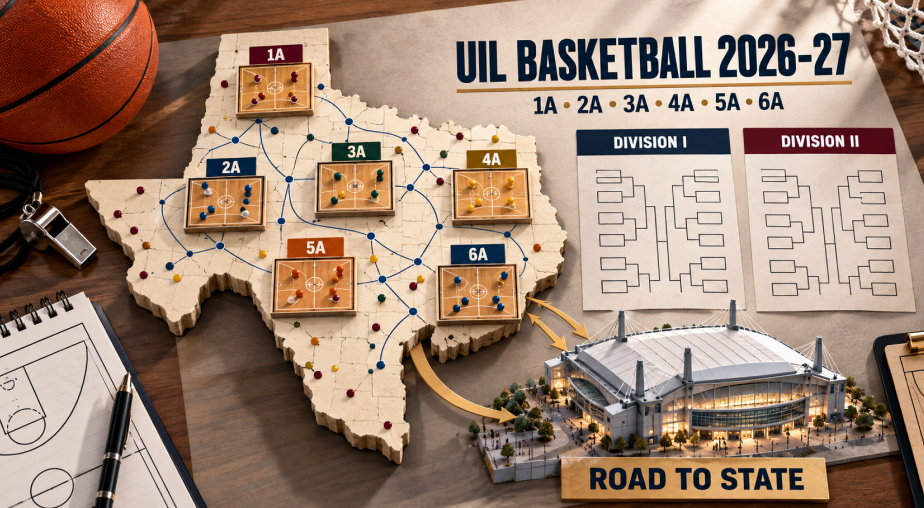
The UIL lists 1,389 basketball schools across Conferences 1A through 6A in its 2026–28 classification figures. That scale illustrates why Texas high school basketball encompasses substantially different competitive environments.
For coaches, realignment can change more than the names appearing on a schedule.
A new district may introduce unfamiliar defensive systems, different travel requirements and opponents with contrasting roster depth. Programs that previously understood their district competition may need to rebuild scouting reports and reconsider their approach to particular matchups.
The implications extend to player development. A team moving into a more demanding district may need to improve defensive rebounding, ball security and execution against pressure to remain competitive.
Rather than judging the new alignment solely by the reputation of opposing schools, coaches should examine how their own roster matches up with the playing styles they are likely to encounter.
How District Results Determine The Road To State
The Texas UIL basketball playoffs reward regular-season performance, but postseason qualification is only the beginning of the championship challenge.
Under the UIL’s postseason structure, the top four teams from each district in Conferences 1A through 6A advance to the playoffs.
Those four qualifying teams are separated into Division I and Division II brackets according to school enrollment. The two advancing schools with the largest reported enrollments enter Division I, while the other two enter Division II.
Each division competes for a separate state championship.
The UIL basketball postseason rules explain the qualification and divisional placement procedures, including the use of enrollment figures submitted in October 2025.
This structure creates several strategic considerations.
Finishing among the district’s top four is essential, but qualifying teams must also prepare for a postseason bracket that can present unfamiliar opponents and different competitive conditions.
The playoff schedule provides little room for extended adjustments. Teams must advance through bi-district, area, regional semifinal and regional final competition before reaching the state semifinals.
An opponent that plays at a faster tempo or relies heavily on perimeter shooting may require a different defensive approach from the one used during district play.
For that reason, teams with adaptable defensive systems, dependable ball-handlers and balanced scoring options may be better positioned to handle the changing demands of postseason competition.
The Alamodome Remains The Destination For Texas Basketball Champions
The 2027 UIL basketball state finals are scheduled for the Alamodome in San Antonio, bringing championship competition from all six conferences to one of Texas’ most recognizable sporting venues.
The girls’ finals take place March 4–6, followed by the boys’ finals March 11–13.
The UIL’s championship schedule separates the divisions across three days.
| Championship Day | Girls’ Finals | Boys’ Finals | Conferences |
|---|---|---|---|
| Thursday | March 4 | March 11 | 1A and 2A, Divisions I and II |
| Friday | March 5 | March 12 | 3A and 4A, Divisions I and II |
| Saturday | March 6 | March 13 | 5A and 6A, Divisions I and II |
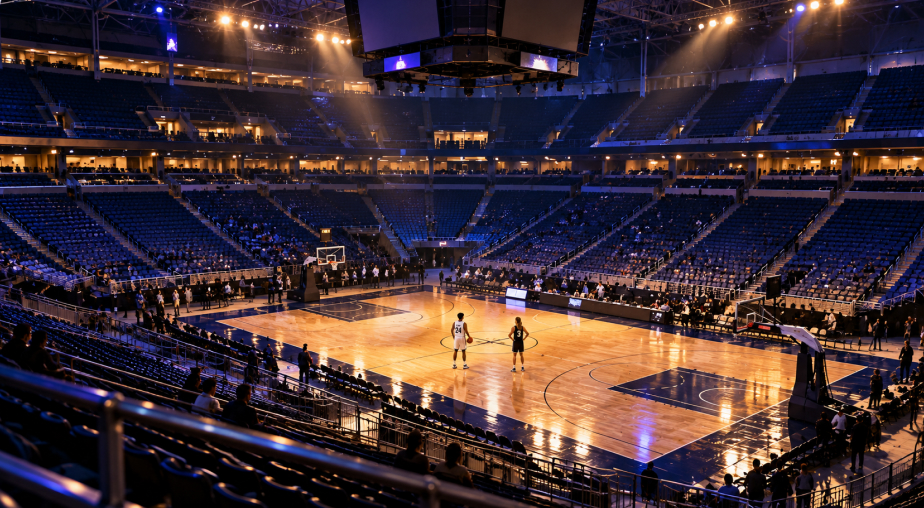
The girls’ state championship schedule and boys’ championship schedule each list 12 championship games, covering Division I and Division II in all six conferences.
For athletes, playing in the Alamodome represents a major change from a typical high school gymnasium.
The scale of the venue, unfamiliar shooting background and championship atmosphere can affect preparation. Teams accustomed to smaller facilities may need to adjust visually and mentally to the larger environment.
However, the most important challenge remains competitive execution.
Teams that reach San Antonio will have survived multiple playoff rounds against increasingly difficult opposition. By that stage, familiarity with offensive responsibilities, defensive communication and late-game situations becomes particularly valuable.
The state finals reward more than individual talent. They test whether a team can execute its identity when the stakes are highest.
What Coaches Should Prioritize Before November
The short October practice period makes preparation choices especially important.
Coaches cannot realistically perfect every element of team performance before the first scrimmage. Instead, they must identify the fundamentals most likely to influence early competitive results.
Defensive positioning should be a priority because communication and coordinated rotations can reduce the number of easy scoring opportunities an opponent receives.
Ball security is equally important. Turnovers not only eliminate scoring opportunities but can also create transition chances for the opposing team.
Rebounding provides another early measure of team readiness. Programs that consistently finish defensive possessions can limit second-chance points even when their offensive execution is still developing.
Coaches also need to establish a manageable offensive structure. A small number of well-executed actions can be more effective than an extensive playbook that players have not yet mastered.
Player development must remain central to the process.
For younger athletes entering varsity competition, October practices offer opportunities to improve decision-making, physical readiness and confidence within a defined role. Returning players can contribute by reinforcing communication standards and helping new teammates understand the program’s expectations.
These priorities apply across Texas, whether a program competes in a large 6A district or represents a smaller rural school.
Why Early-Season Development Matters More Than November Rankings
Early results will inevitably influence how Texas basketball programs are discussed once the regular season begins.
Strong performances can attract attention, while unexpected losses may raise questions about roster strength or coaching decisions.
Yet November rankings and records provide only a partial picture of a team’s eventual championship potential.
A program incorporating several inexperienced players may struggle initially before developing stronger chemistry. Another team may begin with an impressive record but encounter difficulties when district opponents identify weaknesses in its offensive structure.
The more useful evaluation focuses on progress.
Are turnovers decreasing? Is defensive communication improving? Can the team generate quality shots against different defensive schemes? Are younger players becoming more comfortable with their responsibilities?
Those questions provide insight into whether a team is developing the characteristics required for postseason success.
The UIL’s February certification deadlines create a clear timeline for that development. Teams must improve quickly enough to qualify, but they also need to avoid peaking before the most demanding portion of the schedule.
October Preparation Will Shape The 2027 Championship Race
The 2026–27 Texas UIL basketball season begins with two dates that appear straightforward: October 21 for girls’ practice and October 28 for boys.
Their importance becomes clearer when viewed against the entire championship calendar.
Between those October openings and the March state finals, teams must establish identities, navigate new district alignments, develop young athletes and compete for postseason positions.
The competition spans more than 1,300 participating schools, from the largest metropolitan programs to small communities where high school basketball plays a central role in local sports culture.
For coaches, the immediate priority is preparation. For players, it is converting individual improvement into dependable team performance.
The Alamodome may be the destination, but the habits required to reach San Antonio begin taking shape during the first official practices of October.